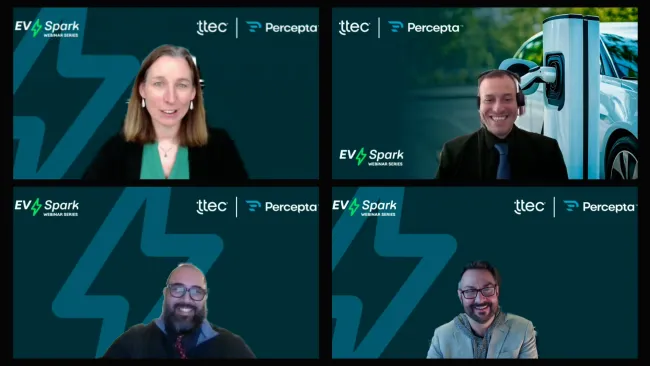
We talked talk to Percepta’s Mark Meikle-Braes about what telematics data drives the most uptime impact, how deep driver understanding leads to better fleet operations, and what fleet telematics looks like for EVs.
TRANSCRIPT:
Hi, and welcome to the CX Pod. I'm your host, Liz Glagowski of the Customer Strategist Journal. For this episode, we are talking about the automotive industry and specifically the business side, fleet operations, where goods get shipped, services get completed, and money gets made. The automotive industry is in the midst of an amazing technological and CX evolution. EVs, self-driving vehicles, even the service experience are all changing. And most of it is powered by data or telematics. So today, I'm pleased to welcome Mark Miekle-Braes of Percepta to discuss opportunities that might be hidden in fleet telematics to enhance uptime and drive revenue. Welcome, Mark.
Mark Meikle-Braes:
Hello, very nice to talk to you today.
Liz Glagowski:
Excellent. I really do appreciate your time. It's an important topic in the automotive industry, and I'm really happy that you're here because you're such an expert. So before we dive in, can you give us a quick intro about you and your work at Percepta?
Mark Meikle-Braes:
Yes, of course. I am the Global Operations Program Manager at Percepton. What I do here is basically all connected vehicles, all things connected vehicles. I'm involved in the sales and onboarding as well as the customer success side of the programs. And our key drivers in that space is to make sure customers are getting the right fleet technology. We're supporting them from a customer service point of view and we're helping them overall to maintain better fleets and uptime.
Liz Glagowski:
Great. So let's start there. Why is uptime really considered the most critical metric for fleet and how can telematics support that?
Mark Meikle-Braes:
That's exactly what our technology plugs into, is making sure that those data insights and all the support that technology provides, as well as the customer care that we offer in between that helps that vehicle stay on the road for longer, helps your business produce what it needs to produce and keep up with the level that it needs to be.
Liz Glagowski:
So It's such a changing industry. Technology is advancing every day. So what's new that you're seeing when it comes to telematics? And what are some trends that fleet owners and operators should really be aware of that maybe they're not?
Mark Meikle-Braes:
Telematics provides you with so much data, insights and information. And it's not just about seeing it as like a reactive tool. You need to use it as a proactive tool. And that's where it's really evolved. We are educating small fleets, medium-sized fleets and big fleets on how to effectively use those tools to really help you drive your business forward, not just track where your drivers are, to keep your vehicles on the road, to understand when you need servicing and plan that in advance rather than reacting to repairs. So it offers so much more than just a GPS tracker and it's evolved extremely far over the last couple of years as technology does.
Liz Glagowski:
So do you have some examples of some of those new telematics or features beyond those GPS ones that maybe people might not be aware of?
Mark Meikle-Braes:
Yeah, there's plenty of features like that that tracks driver behavior, vehicle health. You can track everything from your-- you can set geofences and you can-- there's features with all the technology that is in place today, there's so many features that you use. in a proactive way. And it's also not just about collecting data. It's how you are using that data to actually tell you a story about what's going on with your vehicles, with your investment. Because people spend a lot of money on their vehicles, getting their fleets in place, and they spend a lot of money looking after their drivers. These sort of tools help you combine a better service from both, both your vehicle and your actual driver. So you would tap into everything from not just, your tracking, but also, fuel and health and battery degradations, just to name a few. But there's so much that's come into the telematics space.
Liz Glagowski:
Right. Now, I know there are some concerns about privacy and data and how that all As you collect more data, is there privacy issues or security issues? So how does that play into what you're doing with your customers and clients?
Mark Meikle-Braes:
Yes, and then obviously Europe is one of those focus areas in terms of data privacy. It's a big topic over here, not that it's not important anywhere else, but in particular, yeah, they are you know, local and regional restrictions on how data is used, how tracking, what tracking is allowed and when and where personal tracking versus business tracking and so forth. You know, what data is available that is appropriate for fleet managers to see and manage their business versus what is personal for their drivers. example of that is certain regions won't allow you to track their drivers over the weekends when they're not working, which makes a lot of sense. Should they use their vehicles for both business and personal, perhaps? And yeah, we see that as a particular trend in Europe with GDPR, for instance. So it's more than just the efficiency and the driver experience is also making sure that you can protect the personal data.
Liz Glagowski:
Great. there's a lot of nuance there. So it's good to have an expert to really understand all those little pieces. So let's talk about then some of those hidden insights that might be available that people who are either new to the space or haven't really taken a look at it recently might be unaware of. So what are some, what telematics data drives the most uptime and what kind of impact is it having? How has it changed over the past few years? And Who might actually, I'm curious, who might actually be responsible in an organization for uncovering those insights?
Mark Meikle-Braes:
When you move from a kind of like reactive repair kind of mindset to a more proactive or service maintenance planning mindset, that's when you truly start to unlock the ability of managing your uptime. All vehicles need repair or maintenance in some form. your batteries, your batteries degradation is something you've got to focus on. If that falls into a repair cycle, you want to know about that proactively. You don't want to wake up in the morning, try to start your vehicle and have to phone your boss and say, well, it's not starting. We're losing a day of production. These tools tell you in advance that is a problem and you should get that sorted out in advance and you can plan for that. When things are all reactive, you can't plan for that and you lose money and you lose efficiency and you lose time. So included in that might be other things like, you know, your tire pressure checks, very simple things, or just your engine diagnostics, brake wear, anything else like that about your vehicle that can tell a story and you can use that to proactively manage rather than reactively manage it. And of course, coming back to the human side of it, you spoke about both the fleet managers, but also the actual people that use the vehicles. It's also a safety aspect, right? So you'd like to know if there's a problem with your braking system or your engine ahead of time, rather than driving that vehicle around day to day and something potentially happening down the road.
Liz Glagowski:
So we can't talk about telematics without and fleet without talking about the drivers. So humans are that critical piece of the uptime equation. So can you talk about telematics from both the driver perspective and the fleet manager perspective of where the driver fits in and how they can really help improve their uptime by understanding some of that data and making use of it?
Mark Meikle-Braes:
Yes, of course. So humans are obviously a critical part of the equation when it comes to fleet management. And The real important piece here is that drivers move away from the mindset of Big Brother watching me because my car's just being tracked of where I go. That's not the point. The health and safety aspect, you know, making sure that vehicle is properly maintained and that's a safe vehicle to drive is the important part for the human element. Where drivers feel supported in these situations, they produce more. They obviously have better utilization of the vehicle and they have better route planning so that they don't end up driving in the wrong direction and end up wasting time perhaps and make sure that they can get all their deliveries done in time and get home on time. I mean, that is a very big part of of supporting the driver from a human point of view. So there's so many things that technology can do to make it a better human and driver experience so that it's not just seen as big brother, it's seen as a support tool to those individuals.
Liz Glagowski:
So of course we can't talk about automotive without talking about electric vehicles. so what in the fleet world, what do fleet telematics might look like for EV? How might they be a little different? But also, what do leaders need to understand as they start to transition some or all their fleets to electric vehicles?
Mark Meikle-Braes:
So that's a really great question, Liz. The transition to the EV world is really an important transition for your telematics and your overall business strategy. So you would move away, or not move away, but in conjunction with your proactive service maintenance strategy, you would now start to incorporate an EV route planning strategy or just utilization battery degradation monitoring strategy. And I guess overall you'll call that your charging strategy with With EV comes another complex operation of managing how the infrastructure is set up in your region. Some regions are more mature than others, particularly in Europe. So telematics helps you to understand where your closest charging points are, how your battery is performing, how many miles you'll get out of your battery on that particular day, how many vehicles in your fleet are are running low on battery or moving out of their geofence. All of that can be tracked within the telematics solution. So that really combines then your charging strategy with your proactive service and maintenance strategy. And those are two powerful aspects in that transition.
Liz Glagowski:
So what would you say is the biggest takeaway you have for our listeners when it comes to uptime and telematics for fleet?
Mark Meikle-Braes:
I think that the biggest takeaway is definitely that mind shift from your traditional, it's not a tracking unit, it's more than that. It provides you with so much information. It should not just be a data collection tool. This should be a tool that drives insights and helps you run your business more efficiently, cost effectively. And then of course, the charging strategy is the most important part, right? As we move, as the world moves to the electric, the EV world, the EV strategy, your EV strategy for your fleet is important and you need tools that can support that. And it should never be lost on the fleet manager to have that tool available to them 24-7 or whenever they are running their operations.
Liz Glagowski:
So anything else you wanted to add about the importance of uptime and fleet telematics that maybe we didn't cover?
Mark Meikle-Braes:
Yeah, I mean, it's always like I said, we live in a world of technology. We have so many solutions to support that, not just the telematics, but also the people behind the telematics. Some of what we do is also support small fleets that might not have telematics or even bigger fleets that might not have fleet managers. We help educate individuals on how to use their systems properly and efficiently to get that data insight out of their data rather than just collecting data and not knowing what to do with it. So it's important that you really learn how to use your tool efficiently. and your vehicle efficiently so that when you move towards the electric world or the combination of that, you are really using your fleet to the optimum mobility.
Liz Glagowski:
Great. Well, thank you so much, Mark. It's been a pleasure. I really love tapping into your expertise on this topic and I hope we can do some more of these in the future.
Mark Meikle-Braes:
Thank you very much, Liz. It was great to talk to you today.